

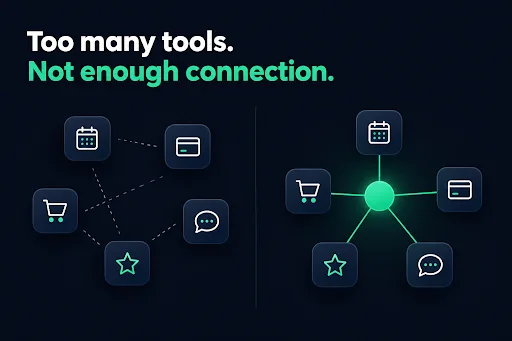
Most businesses don’t start broken. They start scrappy. A booking app here. A payment terminal there. A loyalty program from some other vendor. A spreadsheet to track it all.
Each tool made sense when it was added. But over time, the stack grows. And nothing talks to anything else.
That’s where the problems begin.
What Disconnected Systems Actually Look Like
Picture a busy salon on a Saturday morning.
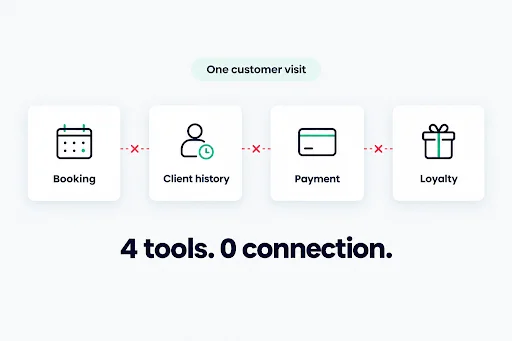
A customer walks in for their appointment. The receptionist checks one app for the booking. Then opens another screen to look up their service history. Then switches to the POS to process payment. Then manually logs a loyalty point in yet another system.
Four tools. One transaction. Zero connection between them.
Now picture a restaurant. Orders come through a POS. Reservations live in a separate app. Customer feedback goes to an email inbox nobody checks. The owner wants to know which dishes drive repeat visits. Good luck pulling that answer together.
This is what most small and mid-size businesses deal with every day. Not one big failure. Just dozens of small disconnects that pile up.
The Hidden Costs You Stop Noticing
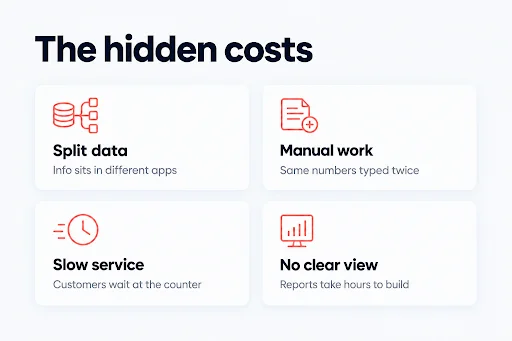
Disconnected systems don’t send you a bill. They quietly drain your time, money, and energy in ways you stop seeing because they feel normal.
1. Data Lives in Silos
Your customer data is split across three or four platforms. Your salon knows a client’s booking history but not their spending pattern. Your restaurant knows what people ordered but not how often they come back.
When data is fragmented, you can’t see the full picture. And you can’t make smart decisions with half a picture.
2. Manual Work Eats Hours
Staff re-enter the same information in multiple places. A food truck owner logs daily sales in the POS, then types the same numbers into a spreadsheet, then manually updates inventory.
That’s not productivity. That’s copying and pasting your way through the day.
3. Customer Experience Suffers
A retail store runs a loyalty program. A regular customer walks in, makes a purchase, and asks about their points. The cashier has to open a separate app, search their name, and hope the records are up to date.
The customer waits. The line grows. The experience feels clunky.
Customers don’t care how many tools you use behind the counter. They care about speed, accuracy, and feeling recognized.
4. You Lose Visibility Into Your Own Business
When your systems don’t connect, reporting becomes a project instead of a glance. You end up pulling numbers from five different dashboards just to understand last month’s performance.
By the time you have the answer, the moment has passed.
When Integration Is Enough
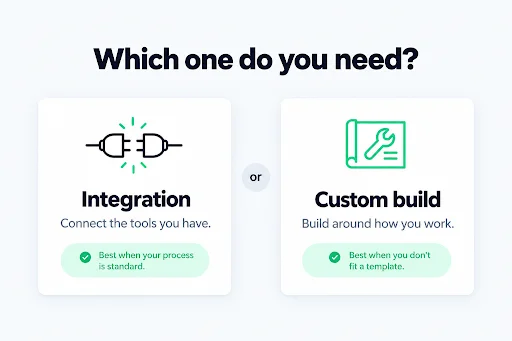
Sometimes, the fix is simple. You already have good tools. They just need to talk to each other.
API integrations, middleware platforms, and plug-and-play connectors can bridge the gaps. If your POS, booking system, and CRM all support integrations, wiring them together might solve 80% of the problem.
This works well when your tools are solid individually and your workflows are fairly standard.
But here’s the catch. Integrations connect tools. They don’t unify them. You’re still managing multiple platforms, multiple logins, multiple update cycles. And when one tool changes its API, the whole chain can break.
When Custom Development Makes Sense
Some businesses have workflows that off-the-shelf tools can’t handle. A wellness studio that combines memberships, class bookings, retail product sales, and practitioner scheduling might not find a single platform that does it all well.
In those cases, custom development fills the gaps. Purpose-built modules, tailored dashboards, or custom APIs that connect your specific stack the way your business actually runs.
It costs more upfront. But it pays off when your business model doesn’t fit neatly into a generic template.
How a Connected Ecosystem Changes Everything
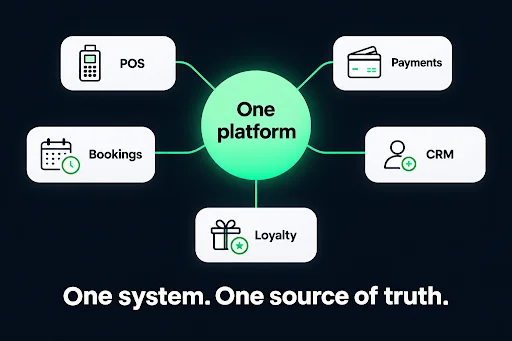
Now imagine the opposite of everything above.
A customer books an appointment online. When they arrive, the system already knows their name, their preferences, and their history. Payment is processed in the same platform. Loyalty points update automatically. The owner sees the revenue hit the dashboard in real time.
One system. One source of truth. No copying, no switching, no guessing.
Here’s what that actually changes:
Time: Staff spend less time on admin and more time on the actual work.
Accuracy: Data enters once and flows everywhere it needs to go.
Experience: Customers feel the difference when things are seamless.
Decisions: Owners see what’s happening now, not what happened two weeks ago.
This isn’t a luxury. For restaurants, salons, retail shops, food trucks, and wellness businesses, this is the baseline for running well.
Ready to Connect Your Business?
DASA Tech brings your POS, payments, bookings, CRM, and loyalty into one platform. No more juggling. No more gaps. Just one system that runs the way your business should.
Visit dasatech.io to see how it works.